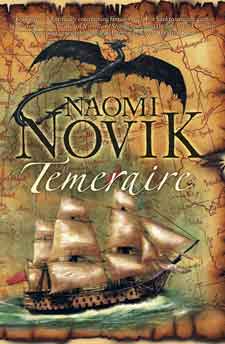
First off, I would have to say that series wouldn’t have caught my attention had it not been for the news that Peter Jackson (LOTR, Heavenly Creatures) was actually thinking of adapting this series of novels into the silver screen. Knowing Peter Jackson’s film-making skills and propensity for seeking out interesting projects, I got curious and checked out a few reviews and inevitably, the excerpts.
Another factor that enticed me to check out this saga was that it dealt with Napoleonic wars. Actually, my main interest lies in the Peninsular war, which is more or less an important chapter in this tumultuous era. At the time, I wondered how Naomi Novik (the author) would weave this campaign into her entertaining saga (5 books and counting).
The first book in this series, His Majesty’s Dragon, is anchored around the time when Napoleon was busily carving out his empire and England’s superior naval forces were ruling the seas. In this alternate reality, dragons exist for real and are used by many countries as centerpieces of their aerial forces (precursors for modern-day scout planes, fighters and bombers), which is a refreshing premise to say the least. This tale features a few twists: Admiral Nelson survives the Battle of Trafalgar and this crucial sea battle itself serves as a ruse to draw out Britain ’s naval forces while French units are being ferried across the channel.
Summary. After seizing a dragon egg from a captured French frigate, the crew and officers of HMS Reliant realized with dismay that the egg was only days away from hatching. Contrary to their hopes of sharing the bounty (that is, if the egg could be safely handed to the proper authorities), it was evident that one of them would have to volunteer as its ‘handler’, a fate that no self-respecting naval officer could possibly wish for. Or else, let the dragon go feral (wild) — which was even worse, because England only has a few first-rate combat dragons.
After hatching, the fully articulate, black (an unusual color) dragonet unexpectedly takes to Capt. William Laurence, who manfully accepts his fate and promptly gives up his command. He names the dragon Temeraire. Later, he learns from an expert that his charge was a Chinese imperial, a rare and highly prized oriental breed known for their intelligence and grace. It does not take long for the two to bond, and after a few weeks they proceed to Loch Laggan in Scotland for intensive training.
There, they meet other dragons of various sizes and breeds — although Temeraire is clearly different from anyone else — as well as aviators (including a few female handlers) and ground crews. Training was hard, but the training instructor (a dragon!) is pleased to discover that aside from being a fast and highly maneuverable flyer, Temeraire has the unusual ability to "hover" -- meaning he can fly in place for a long period.
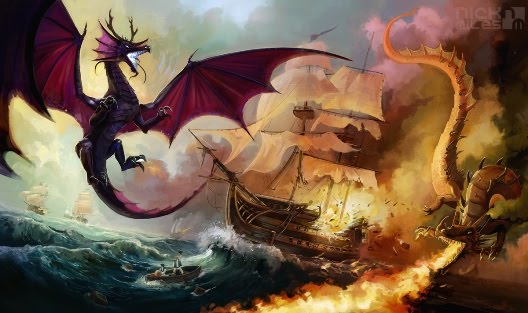
A few months later, news of England ’s victory in Trafalgar reaches the covert. Everyone celebrates. However, they soon learn with dismay that this huge naval engagement is merely a ploy. And while most of the country’s aerial forces are away to assist Nelson (Battle of Trafalgar), only a few inexperienced combat-weight dragons are left to protect England’s coast against an imminent French invasion. In this desperate, climactic aerial battle, Temeraire realizes his full powers, and consequently his real identity.
It is later revealed that Temeraire is not just an imperial, but rather a Chinese celestial — the rarest and the most highly prized of dragon breeds, raised as companions to the immediate members of the Chinese imperial family. It also becomes apparent that Temeraire had been intended as a gift to Napoleon, judged by the Chinese (acknowledged the world’s best dragon breeders) as a fitting recipient being an emperor himself.
His Majesty’s Dragon is a highly entertaining read. The bond between Capt. Laurence and Temeraire is touching and palpable. The gripping aerial dogfights (err, dragonfights?) will keep you vastly entertained. With their ability to communicate and work with their crew and fellow dragons, Ms. Novik’s dragons add a fascinating dimension to aerial battles (it’s pretty hard to remain detached and focused on your mission when you can hear a dragon roar in pain).
Fans of fantasy books who are also history buffs will find plenty to like in this series. It doesn’t quite have the multi-layered complexity and the gracious prose of Susanna Clarke’s Jonathan Strange and Mr Norrell, but it’s still a highly fascinating tale.
Showing posts with label fantasy. Show all posts
Thursday, March 31, 2011
Monday, January 17, 2011
Jonathan Strange & Mr Norrell
the moment Susanna Clarke's Jonathan Strange & Mr Norrell (JS&MN) became available in local bookstores, i shifted to active search mode. its hefty price and weight (which was taxing on one’s wrist) gave me some pause, but after reading several glowing reviews i threw caution to the wind and bought a hardbound copy.
so was it worth the hassle? you bet.
i was barely halfway into the first chapter when i realized that i was truly ensnared with no hope of turning back. i raced through that 782-page volume like a hound hot on a scent. after finishing the book in 1.5 days (i still had to report for work), i went through it again —- this time, i savored every page and paused at every nook and cranny, including the footnotes.
i’d been trying to convince a lot of people since then to read JS&MN, but except for a couple of sci-fi/fantasy geeks at work, it didn’t really catch on among my friends and colleagues. i think the book’s length and ms. clarke’s writing style (which mirrors the style and conventions adopted by many authors of that era — particularly Jane Austen) must have put them off.
after i had raved about it for weeks, a friend asked me why i liked it so much. for some reason, that question floored me for a few seconds. i mean, how do you explain why you like something so much without sounding like an obsessive nutcase?
i finally blurted, “just read the book. you'll know why.”
i could have cited several things: susanna clarke‘s storytelling gifts, the elegant way she paints a scene (which would normally take lesser authors many paragraphs to convey and many years to perfect), and her beguiling way of convincing you that such things could have actually happened.
the thing about Jonathan Strange & Mr Norrell is that the tale unfolds with a deceptively reasonable and gently (and at other times, sly) teasing tone so as to make you believe its premise with unsettling ease and amused wonder.
i suppose that my fondness for JS&MN partly stems from my affection for Jane Austen’s books (haven’t read all of them though) and the fact that i like fantasy/sci-fi books in general. i have also devoured georgette heyer’s books, which are an excellent source of Regency social vignette and humor. in addition, ms. clarke manages to infuse her tale with some of the period’s famous historical figures, which can be a clever way of grounding a story (despite the fact that it’s a revisionist tale).
i just wish there were more books like this. oh, i also recently bought ms. clarke’s latest book, The Ladies of Grace Adieu, a collection of short stories relating to JS&MN’s story line. a delightful read, that. beautiful illustrations, too.
so was it worth the hassle? you bet.
i was barely halfway into the first chapter when i realized that i was truly ensnared with no hope of turning back. i raced through that 782-page volume like a hound hot on a scent. after finishing the book in 1.5 days (i still had to report for work), i went through it again —- this time, i savored every page and paused at every nook and cranny, including the footnotes.
i’d been trying to convince a lot of people since then to read JS&MN, but except for a couple of sci-fi/fantasy geeks at work, it didn’t really catch on among my friends and colleagues. i think the book’s length and ms. clarke’s writing style (which mirrors the style and conventions adopted by many authors of that era — particularly Jane Austen) must have put them off.
after i had raved about it for weeks, a friend asked me why i liked it so much. for some reason, that question floored me for a few seconds. i mean, how do you explain why you like something so much without sounding like an obsessive nutcase?
i finally blurted, “just read the book. you'll know why.”
i could have cited several things: susanna clarke‘s storytelling gifts, the elegant way she paints a scene (which would normally take lesser authors many paragraphs to convey and many years to perfect), and her beguiling way of convincing you that such things could have actually happened.
the thing about Jonathan Strange & Mr Norrell is that the tale unfolds with a deceptively reasonable and gently (and at other times, sly) teasing tone so as to make you believe its premise with unsettling ease and amused wonder.
i suppose that my fondness for JS&MN partly stems from my affection for Jane Austen’s books (haven’t read all of them though) and the fact that i like fantasy/sci-fi books in general. i have also devoured georgette heyer’s books, which are an excellent source of Regency social vignette and humor. in addition, ms. clarke manages to infuse her tale with some of the period’s famous historical figures, which can be a clever way of grounding a story (despite the fact that it’s a revisionist tale).
i just wish there were more books like this. oh, i also recently bought ms. clarke’s latest book, The Ladies of Grace Adieu, a collection of short stories relating to JS&MN’s story line. a delightful read, that. beautiful illustrations, too.
Sunday, January 2, 2011
How to Train Your Dragon (book)
i was idling my time away last Sunday (i was waiting for the traffic to clear so i could go home in relative peace), so i stopped at Booksale for a quick browse. after 15 minutes i grew bored and was about to leave when i glanced in a corner and saw this book (How to Train Your Dragon).
it was still in relatively good condition, which was probably why it caught my attention.
it wasn't the type of book i'd normally check out, but for some reason it called to me. i opened a few pages, and much to my surprise i was actually chuckling before i even finished a page. this rarely happens to me, so i jumped a few pages more and was promptly beguiled by several pages of illustrations inside — no they weren't particularly good or even eye-catching. but the clumsily drawn, stick-like figures (bad spelling and all) blended well with the humorous way the story was laid out.
How to Train Your Dragon is presented as a translation (originally in old Norse, according to its playfully imaginative author, Cressida Cowell) of the memoirs of a famous Viking chieftain, Hiccup Horrendous Haddock III (yes, that's his name) -– specifically on how he progressed from being an undersized but sensible warrior wanna-be to a still-undersized but moderately acceptable Viking hero by training his own undersized, unremarkable and ornery dragon (which he calls Toothless -– go figure).
This book is basically geared for male juveniles but grown-ups with an overdeveloped sense of humor will also appreciate its concept and humor (both slapstick and implied).
with characters endearingly named as Hiccup (son of the chieftain of the Hairy Hooligans), Thuggory (his counterpart in the Meathead tribe), Gobber the Belch, Snotface Snotlout, Dosgbreath the Duhbrain, how can you go wrong? anyway, if you're looking for mindless fun and are fond of Viking culture, How to Train Your Dragon (HTTYD) is right up your alley. enjoy.
NOTE: of course, everybody now knows that this amusing book has already been adapted into film (starring Gerard Butler, Jay Baruchel, America Ferrera, etc.) by DreamWorks -- it is one of the top boxoffice earners for 2010 after all. however, there's a world of difference between the movie and book versions of HTTYD. and although i loved the film, i would have to say that the book version has a unique brand of attraction that will probably never translate well into film.
it was still in relatively good condition, which was probably why it caught my attention.
it wasn't the type of book i'd normally check out, but for some reason it called to me. i opened a few pages, and much to my surprise i was actually chuckling before i even finished a page. this rarely happens to me, so i jumped a few pages more and was promptly beguiled by several pages of illustrations inside — no they weren't particularly good or even eye-catching. but the clumsily drawn, stick-like figures (bad spelling and all) blended well with the humorous way the story was laid out.
How to Train Your Dragon is presented as a translation (originally in old Norse, according to its playfully imaginative author, Cressida Cowell) of the memoirs of a famous Viking chieftain, Hiccup Horrendous Haddock III (yes, that's his name) -– specifically on how he progressed from being an undersized but sensible warrior wanna-be to a still-undersized but moderately acceptable Viking hero by training his own undersized, unremarkable and ornery dragon (which he calls Toothless -– go figure).
This book is basically geared for male juveniles but grown-ups with an overdeveloped sense of humor will also appreciate its concept and humor (both slapstick and implied).
with characters endearingly named as Hiccup (son of the chieftain of the Hairy Hooligans), Thuggory (his counterpart in the Meathead tribe), Gobber the Belch, Snotface Snotlout, Dosgbreath the Duhbrain, how can you go wrong? anyway, if you're looking for mindless fun and are fond of Viking culture, How to Train Your Dragon (HTTYD) is right up your alley. enjoy.
NOTE: of course, everybody now knows that this amusing book has already been adapted into film (starring Gerard Butler, Jay Baruchel, America Ferrera, etc.) by DreamWorks -- it is one of the top boxoffice earners for 2010 after all. however, there's a world of difference between the movie and book versions of HTTYD. and although i loved the film, i would have to say that the book version has a unique brand of attraction that will probably never translate well into film.
Tuesday, December 28, 2010
revisiting Ladyhawke
last night, i was finally able to watch Ladyhawke – probably the most memorable fantasy picture i've seen (with the single exception of LOTR, which is the gold standard for all fantasy flicks as far as i'm concerned).
i saw this film years ago, and i remember diligently searching for a copy of it (vcd, dvd, blue-ray) afterwards in local video stores, including trips to tiangge stalls that specialize in pirated goodies, with zero results. fortunately, my younger sister sent a batch of DVDs last week — and to my utter delight, Ladyhawke was actually in that pile.
featuring michelle pfeiffer, rutger hauer and a youthful matthew broderick, this 1985 film combines an irresistible mix of fantasy, romance, action (swords and stuff), with a dash of humor thrown in for good measure. what made this movie click for me was its note-perfect cast, beautiful storyline and gorgeous locations. however, i will have to note that i found the use of contemporary tracks rather jarring.
the film's premise: Isabeau (pfeiffer) and Navarre (hauer) are the star-crossed lovers cursed by the cruel and evil bishop of Aquila, who wants Isabeau for himself, to be…

by day Isabeau turns into a hawk, and by night Navarre becomes a wolf. to escape the bishop's vengeful clutches, the fugitive pair travels together, but never simultaneously in their human form — never able to communicate or even catch a glimpse of the other. along the way, they encounter Mouse (broderick), a thief who had escaped from the dungeons of Aquila…
michelle pfeiffer never looked so enchanting and hauntingly ethereal (it darn near breaks your heart), and rutger hauer — one of the most underrated actors around — is dashing and irresistible as a brooding romantic lead. for once, matthew broderick looks appropriately young and irreverent in his pivotal role as a comic relief and reluctant conduit to the doomed pair. his cheeky remarks to God, as he squirms and cons his way out of trouble, serve as a droll commentary throughout the film; it saves Ladyhawke from becoming too serious for its own good.
i saw this film years ago, and i remember diligently searching for a copy of it (vcd, dvd, blue-ray) afterwards in local video stores, including trips to tiangge stalls that specialize in pirated goodies, with zero results. fortunately, my younger sister sent a batch of DVDs last week — and to my utter delight, Ladyhawke was actually in that pile.featuring michelle pfeiffer, rutger hauer and a youthful matthew broderick, this 1985 film combines an irresistible mix of fantasy, romance, action (swords and stuff), with a dash of humor thrown in for good measure. what made this movie click for me was its note-perfect cast, beautiful storyline and gorgeous locations. however, i will have to note that i found the use of contemporary tracks rather jarring.
the film's premise: Isabeau (pfeiffer) and Navarre (hauer) are the star-crossed lovers cursed by the cruel and evil bishop of Aquila, who wants Isabeau for himself, to be…

always together, eternally apart
as long as the sun rises and sets
as long as there is day and night
and for as long as they both shall live…
by day Isabeau turns into a hawk, and by night Navarre becomes a wolf. to escape the bishop's vengeful clutches, the fugitive pair travels together, but never simultaneously in their human form — never able to communicate or even catch a glimpse of the other. along the way, they encounter Mouse (broderick), a thief who had escaped from the dungeons of Aquila…
michelle pfeiffer never looked so enchanting and hauntingly ethereal (it darn near breaks your heart), and rutger hauer — one of the most underrated actors around — is dashing and irresistible as a brooding romantic lead. for once, matthew broderick looks appropriately young and irreverent in his pivotal role as a comic relief and reluctant conduit to the doomed pair. his cheeky remarks to God, as he squirms and cons his way out of trouble, serve as a droll commentary throughout the film; it saves Ladyhawke from becoming too serious for its own good.
Labels:
celebrities,
fantasy,
favorites,
films
Monday, December 27, 2010
Peter Jackson and Temeraire
boy, was i glad to hear that Peter Jackson -- he of the Lord of the Rings (LOTR; based on J.R.R. Tolkien's books) films fame -- had acquired the film rights and was making plans to adapt Naomi Novik's Temeraire series to the big screen.i have managed to read the first five books of this popular fantasy series (His Majesty's Dragon, Throne of Jade, Black Powder War, Empire of Ivory, Victory of Eagles), and am already excited to see the whole thing come to life in the silver screen.
Ms. Novik's deft touch in incorporating thrilling action and fantasy elements (dragons!) against a sweeping historical backdrop (Napoleonic wars) resonates with me particularly, because i just happen to love both topics. in this sense, she reminds me of Susanna Clarke whose elegantly crafted Jonathan Strange and Mr Norrell has enthralled and satisfied me on several levels, a feat that only a few books have managed to do.

but before this can come to pass, we can all look forward to watching that well-loved LOTR prequel, The Hobbit. The first of this two-part huge film production, both of which will be directed by Peter Jackson, is scheduled to appear in theaters late in 2012.
Subscribe to:
Posts (Atom)