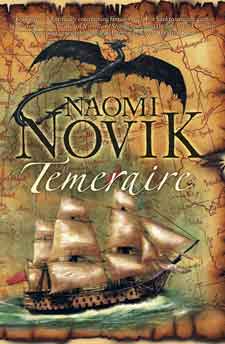
Another factor that enticed me to check out this saga was that it dealt with Napoleonic wars. Actually, my main interest lies in the Peninsular war, which is more or less an important chapter in this tumultuous era. At the time, I wondered how Naomi Novik (the author) would weave this campaign into her entertaining saga (5 books and counting).
The first book in this series, His Majesty’s Dragon, is anchored around the time when Napoleon was busily carving out his empire and England’s superior naval forces were ruling the seas. In this alternate reality, dragons exist for real and are used by many countries as centerpieces of their aerial forces (precursors for modern-day scout planes, fighters and bombers), which is a refreshing premise to say the least. This tale features a few twists: Admiral Nelson survives the Battle of Trafalgar and this crucial sea battle itself serves as a ruse to draw out Britain ’s naval forces while French units are being ferried across the channel.

Summary. After seizing a dragon egg from a captured French frigate, the crew and officers of HMS Reliant realized with dismay that the egg was only days away from hatching. Contrary to their hopes of sharing the bounty (that is, if the egg could be safely handed to the proper authorities), it was evident that one of them would have to volunteer as its ‘handler’, a fate that no self-respecting naval officer could possibly wish for. Or else, let the dragon go feral (wild) — which was even worse, because England only has a few first-rate combat dragons.
After hatching, the fully articulate, black (an unusual color) dragonet unexpectedly takes to Capt. William Laurence, who manfully accepts his fate and promptly gives up his command. He names the dragon Temeraire. Later, he learns from an expert that his charge was a Chinese imperial, a rare and highly prized oriental breed known for their intelligence and grace. It does not take long for the two to bond, and after a few weeks they proceed to Loch Laggan in Scotland for intensive training.
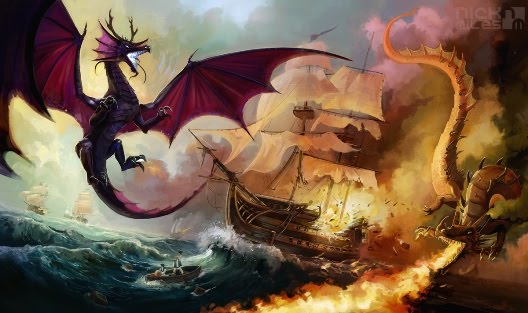
There, they meet other dragons of various sizes and breeds — although Temeraire is clearly different from anyone else — as well as aviators (including a few female handlers) and ground crews. Training was hard, but the training instructor (a dragon!) is pleased to discover that aside from being a fast and highly maneuverable flyer, Temeraire has the unusual ability to "hover" -- meaning he can fly in place for a long period.
A few months later, news of England ’s victory in Trafalgar reaches the covert. Everyone celebrates. However, they soon learn with dismay that this huge naval engagement is merely a ploy. And while most of the country’s aerial forces are away to assist Nelson (Battle of Trafalgar), only a few inexperienced combat-weight dragons are left to protect England’s coast against an imminent French invasion. In this desperate, climactic aerial battle, Temeraire realizes his full powers, and consequently his real identity.

It is later revealed that Temeraire is not just an imperial, but rather a Chinese celestial — the rarest and the most highly prized of dragon breeds, raised as companions to the immediate members of the Chinese imperial family. It also becomes apparent that Temeraire had been intended as a gift to Napoleon, judged by the Chinese (acknowledged the world’s best dragon breeders) as a fitting recipient being an emperor himself.
His Majesty’s Dragon is a highly entertaining read. The bond between Capt. Laurence and Temeraire is touching and palpable. The gripping aerial dogfights (err, dragonfights?) will keep you vastly entertained. With their ability to communicate and work with their crew and fellow dragons, Ms. Novik’s dragons add a fascinating dimension to aerial battles (it’s pretty hard to remain detached and focused on your mission when you can hear a dragon roar in pain).
Fans of fantasy books who are also history buffs will find plenty to like in this series. It doesn’t quite have the multi-layered complexity and the gracious prose of Susanna Clarke’s Jonathan Strange and Mr Norrell, but it’s still a highly fascinating tale.